ArticlesIncentives
Saudi Standard Incentives in practice: what the SAR 50 Mn grant means for your project
How much Saudi Arabia's Standard Incentives really cover on a large factory, how the grant is paid, and what the first results tell applicants.
 Vedran MuharSenior Consultant, MTSI Solutions
Most summaries of Saudi Arabia’s Standard Incentives for the industrial sector stop at the headline: up to 35% of eligible investment costs, capped at SAR 50 million. That is correct, but it is not what a board needs to decide on a new plant. The questions we hear from European manufacturers are more practical. How much of our project will the grant really cover? When is the money paid? How many applications get through?
This article answers those questions. For an introduction to the Program itself, see our earlier article on the Standard Incentive Program (SIP). For the wider mix of grants, loans and zones, see Saudi incentives for foreign manufacturers.
The Program in short
The Standard Incentives were approved by the Council of Ministers in December 2024 and launched in January 2025 by the Ministry of Industry and Mineral Resources together with the Ministry of Investment. The state set aside SAR 10 billion for them.
The core rules are the same for every project, which is why they are called “standard”:
- Purpose: manufacturing of products that are not yet made in Saudi Arabia
- Support: a grant of up to 35% of eligible investment costs, capped at SAR 50 million per project
- Payment: split equally between the construction phase and the production phase, over up to seven years
- Applicants: Saudi and foreign investors alike. The minister has said an investor registered in Saudi Arabia does not have to be a Saudi national
- Evaluation: an inter-ministerial committee checks whether the product is on the target list and what value the project brings
Applications are made through the ministry’s Senaei platform. The target products are published in opportunity lists, and the Program opens in batches:
| Batch | Launched | Sectors |
|---|---|---|
| First | January 2025 | Downstream chemicals, automotive, machinery and equipment |
| Second | June 2025 (applications open from August to mid-November 2025) | Aviation, building materials, medical devices, pharmaceuticals, food processing, maritime, mining |
The second batch alone listed more than 140 target investment opportunities.
The cap matters more than the percentage
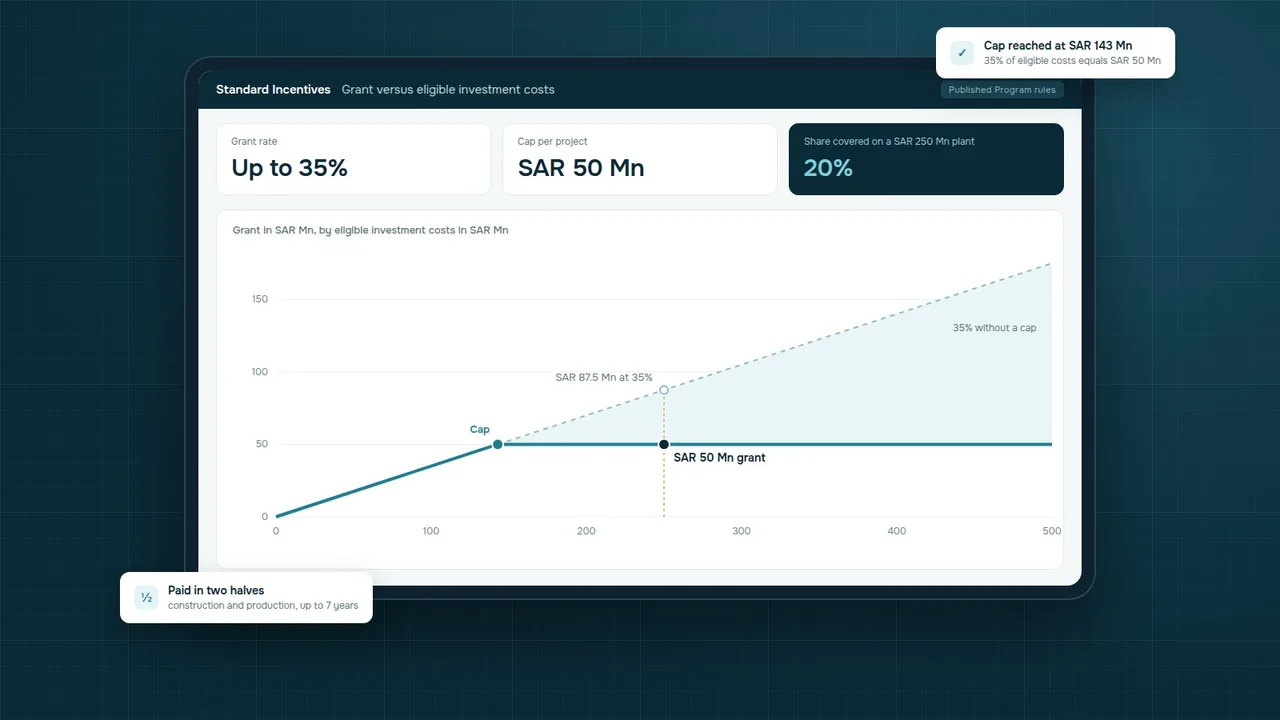
The 35% rate grabs attention, but on a large industrial project the SAR 50 million cap decides the outcome. The cap is reached at eligible investment costs of about SAR 143 million. Above that, the share of the project the grant covers falls quickly.
| Eligible investment costs | 35% of eligible costs | Grant after the cap | Share of eligible costs covered |
|---|---|---|---|
| SAR 100 Mn | SAR 35 Mn | SAR 35 Mn | 35% |
| SAR 143 Mn | SAR 50 Mn | SAR 50 Mn | 35% |
| SAR 250 Mn | SAR 87.5 Mn | SAR 50 Mn | 20% |
| SAR 500 Mn | SAR 175 Mn | SAR 50 Mn | 10% |
The industrial projects we support often have a CAPEX above SAR 250 million. For them, the planning figure is a SAR 50 million grant, or about 20% of eligible costs, not 35%. A financial model built on the headline rate overstates the support by more than SAR 35 million.
The table also shows why the Program suits mid-sized plants well. A focused production line of SAR 100 to 150 million can recover close to the full 35%.
Half the money arrives after production starts
Because the grant is split equally between construction and production, a SAR 50 million award on a SAR 250 million plant means roughly SAR 25 million during construction and SAR 25 million once the plant runs. The second half depends on the plant actually operating as agreed, over a support period of up to seven years.
For the funding plan, this has three consequences:
- Equity and loans must carry the build. Only part of the grant is available while the plant is being built, so the construction phase still needs full financing from equity and debt, for example from the Saudi Industrial Development Fund (SIDF).
- The production half is conditional. Treat it as performance-linked income, not as secured funding, until the milestones in the agreement are met.
- Grant timing belongs in the cash flow model. Lenders and investment committees will look at when the money arrives, not only how much.
What the first results show
By December 2025, the ministry reported:
- more than 500 applications received, with more than 300 still under review
- 9 projects with signed agreements, representing about SAR 2 billion of investment
- 25 more projects with letters of intent, representing about SAR 5 billion of investment
- an expected total of about SAR 24 billion of investment supported by the Program
In other words, at that point fewer than one in ten applications had reached a letter of intent or an agreement. The Program is open to everyone, but it is selective.
The ministry has also said that the incentives are meant to link state support to real economic impact: local content, import substitution, non-oil exports and advanced technology. An application is judged on that case, not only on the size of the investment.
What makes an application stronger
From our work on incentive and financing applications, the projects that move forward usually get four things right:
- The product matches the target list exactly. The Program supports products not yet made in Saudi Arabia. A close match with a published opportunity is the first filter.
- The investment figure is well documented. The grant is a share of eligible investment costs, so the CAPEX must be itemised and supported by quotations. Unsupported figures are the easiest thing for evaluators to cut.
- The feasibility study answers the committee’s questions. Market demand in the Kingdom, the import volumes the plant would replace, local content, jobs and exports should be quantified, not described.
- The company can move quickly. A complete application with committed decision-makers takes about six weeks to prepare. Most delays come from missing documents and slow internal sign-off, not from the drafting.
A useful benchmark: on a project with more than SAR 250 million of CAPEX, a SAR 50 million Standard Incentives application is the right target, and it is worth preparing together with the SIDF loan application, because both rely on the same feasibility study and financial model.
How MTSI helps
MTSI helps industrial investors prepare incentive and financing applications in Saudi Arabia, including the Standard Incentives, SIDF financing, MISA and the National Incentive Committee. We check eligibility against the current opportunity lists, build the feasibility study and financial model, and coordinate the application through to the authorities’ questions. If your company is planning a plant in the Kingdom, talk to us before you fix the funding plan.